A fascinating journey into the post-war German motorcycle industry, where ambitious entrepreneurs like Jakob Oswald Hoffmann reached for the stars with the unique “Baby Boxer”- and flew just a little too close to the sun.
In the immediate aftermath of WW2, just as in similarly bombed-out Britain and equally battle-scarred Italy, occupied West Germany saw an enormous hunger for cheap two-wheeled personal transportation. From bicycles providing basic mobility to whatever motorcycles could be produced by an industry struggling to recover from the depredations of war, the demand was insatiable.
It was a get-rich-quick opportunity for a thrusting entrepreneur like Jakob Oswald Hoffmann, proprietor of Solingen Fahrradfabrik-the Solingen Bicycle Company. His story is one of incredible resilience, engineering ambition, and a dramatic corporate collapse that left behind one of the rarest German motorcycles of the era: the Hoffmann MP250-2 Gouverneur.
The Rise of an Industrialist
Born in Düsseldorf in March 1896 as the son of a retail confectioner, former bank clerk Hoffmann twice tried his hand at the wholesale tobacco trade in his youth. But each time, his business was a casualty of the hyperinflation and uncertainty which beset Germany’s post-Armistice Weimar Republic.
However, resilience was clearly in his nature. In June 1934, J.O. Hoffmann purchased a stake in the Solingen Fahrradfabrik bicycle factory. The company thrived, becoming Germany’s leading exporter of bicycles not only to the Netherlands and Denmark but also to Central America, Africa, and even India.
From 1939 onwards, like so many others in the Ruhr-the industrial heartland of Germany-the factory was diverted to war production. They shifted to manufacturing mines, detonators, and anti-tank grenades. While Hoffmann was awarded the War Merit Cross First Class by Hitler himself in 1943, he notably never joined the Nazi Party-a move that likely saved his postwar career.
From Rubble to Recovery
In 1944, the firm’s main factory in Solingen was badly damaged by Allied bombing. Yet, realising the potential importance of post-conflict bicycle production in a war-ravaged country, Hoffmann made a strategic move. In August 1945, he acquired a massive former steel factory in Lintorf. By the end of the year, Solingen Fahrradfabrik was restarting bicycle production there, with employees churning out around 1,000 bikes a month.
Hoffmann was fortunate to find himself in the British Zone. Unlike other zones, the British administration permitted this kind of industrial endeavour. Thanks to his experience and wartime contacts, Hoffmann knew exactly where to obtain coveted raw materials. He even established a friendly relationship with a Canadian Army liaison officer responsible for requisitioning machinery, who helped ‘redirect’ certain items to Hoffmann.
By 1947, 250 employees were building 2,500 units per month. In February 1950, a large new assembly hall was opened, boasting modern production lines and a paint shop with automatic baking. This steep increase in production came about thanks to Hoffmann’s entry into the Powered Two Wheeler marketplace, initially building frames for DKW and then producing his own small motorcycles powered by Sachs engines.
The Italian Connection: Vespa
On August 9, 1949, Jakob Oswald Hoffmann concluded a licensing agreement that would change everything: a deal with Piaggio to manufacture Vespa scooters in Germany.
Vespas were a smash hit in Italy, but Piaggio was unable to export them to Germany due to Allied prohibitions on trade. To circumvent this, they sold Hoffmann a license to manufacture them locally as Hoffmann-Vespas. The first 125cc Hoffmann-Vespa reached its German customer in March 1950, and over 45,000 examples would follow.
Volumes grew rapidly, and J.O. Hoffmann became a successful industrialist whose reputation resounded as far away as America. With annual Vespa production providing the seed corn capital, Hoffmann decided to move upmarket.
Enter the Gouverneur
He engaged marquee German engine designer Richard Küchen to conceive a twin-cylinder 250cc four-stroke Boxer motor. The Hoffmann MP250 Gouverneur (‘Governor’) debuted at the IFMA motorcycle show in Frankfurt in October 1951.
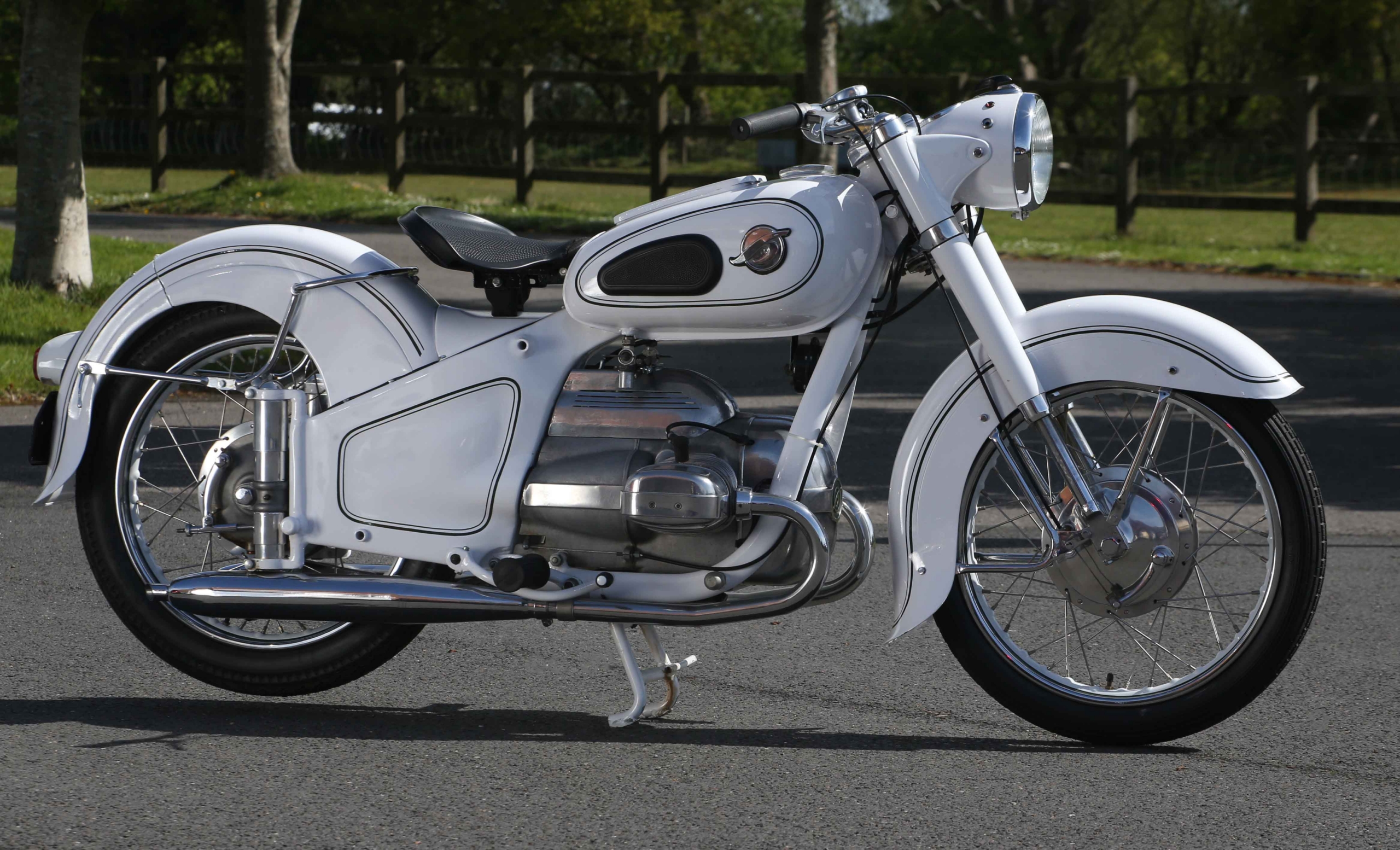
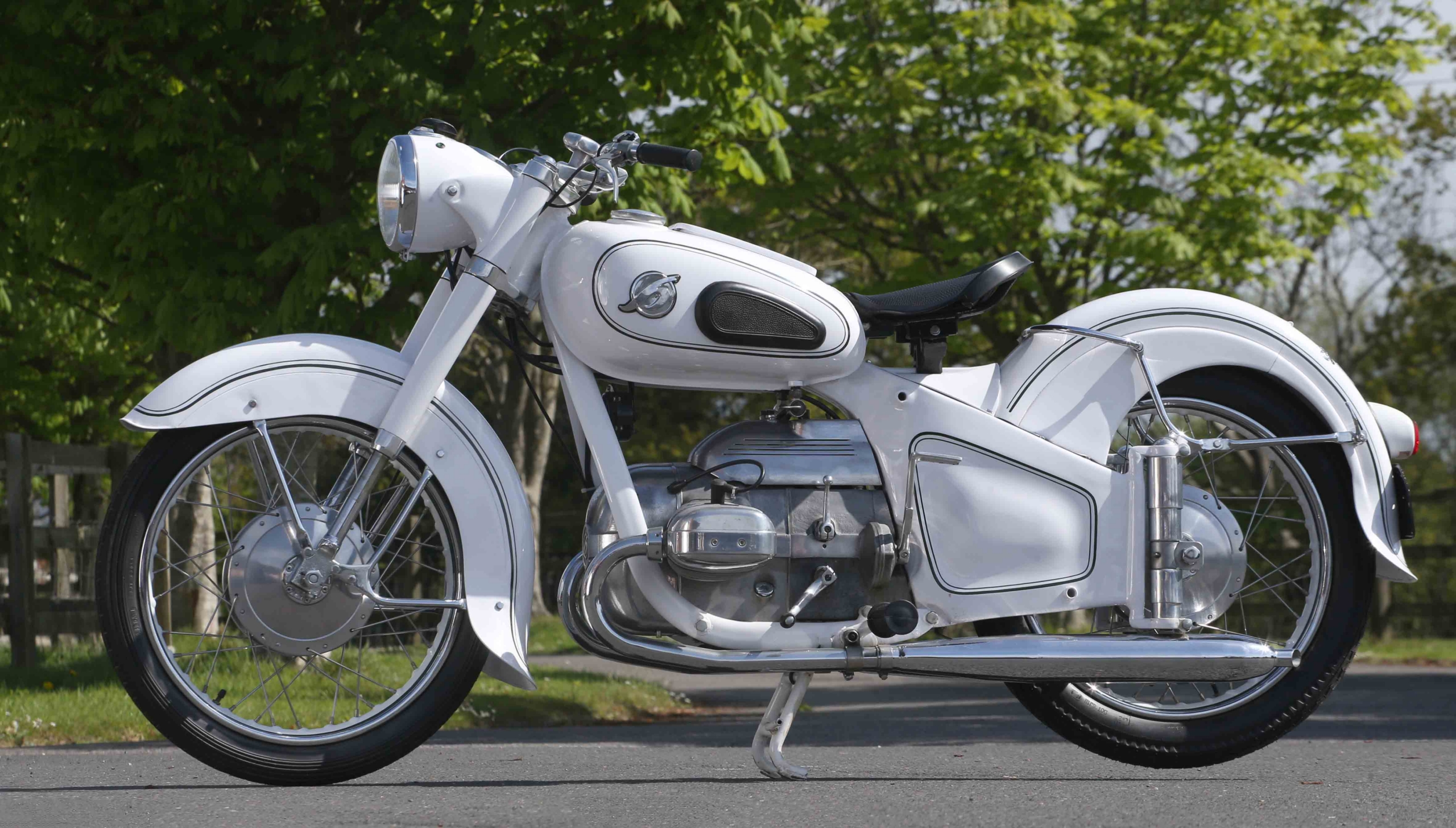
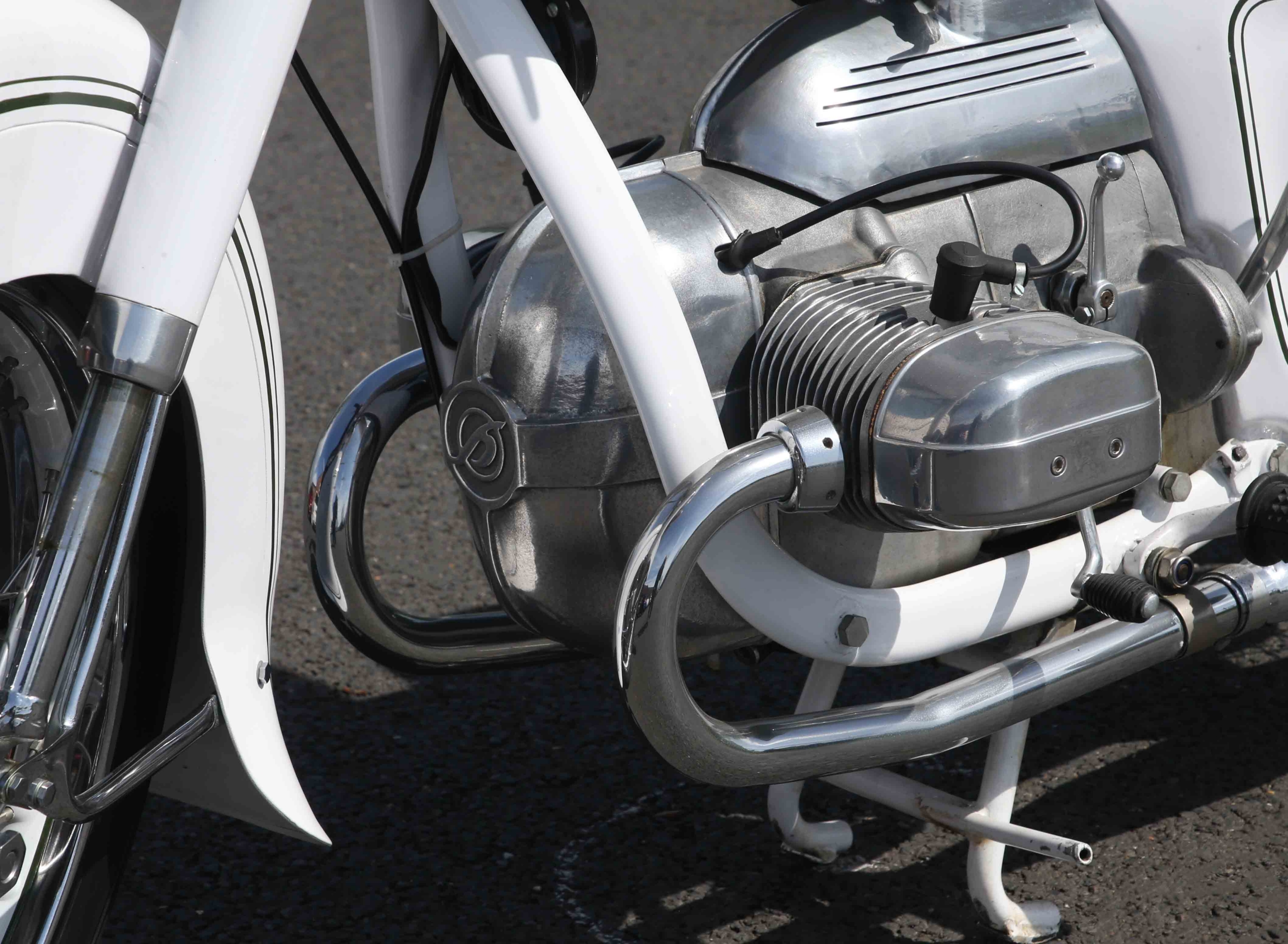
The Hoffmann Gouverneur MP 250 featured a sleek-looking air-cooled short-stroke OHV flat-twin motor. Measuring 248cc, it initially produced a lowly 11 bhp. The chassis was innovative, featuring a pressed-steel spine frame and a 32mm upside-down fork-possibly a world first?-of Hoffmann’s own manufacture.
However, Hoffmann had taken the conscious decision to appeal to the upper end of the market. The MP250 included a lockable tool compartment in the tank, an adjustable central friction damper for the steering, a neutral indicator on the crankcase, and standard sidecar bolt-on connections.
Engineering Ambition vs. Reality
The result was a machine that weighed 150kg dry-a hefty penalty compared to the 140kg BMW R25/3 single. This weight was likely the main reason the Bavarians had declined to extend their trademark boxer engine format to the 250cc class.
Küchen also had a fixation on “smooth surfaces.” His engines looked beautiful but frequently overheated due to excessive shrouding for styling purposes. They were also expensive to build. The Gouverneur MP250 cost DM 2,300 in 1953, significantly more than the better-performing BMW or NSU rivals.
Teething problems with a flimsy crankshaft and lack of performance meant only 450 examples of this first-generation Hoffmann Boxer were sold.
A Refined Successor: The MP250-2
In response, the heavily revised MP250-2 was launched at the 1953 IFMA Show. This new version featured a stiffer crankcase, oval inlet ports, a larger 24mm Bing carburettor, and a higher 7:1 compression ratio. The crankshaft was reinforced, and oilways were modified for better reliability.
By now, the Hoffmann workforce had gained valuable experience in engine assembly. The quality of the new flat-twin finally befitted its price tag. Producing 14.5 bhp at 4,800 rpm, it was a much more viable contender for the customer’s Deutschmark. Around 3,000 examples of the MP250-2 were reportedly sold in 1953-54.
The Downfall of an Empire
Despite the Gouverneur’s modest success, dark clouds were gathering over the Hoffmann company. The primary reason for this was twofold.
Firstly, the Vespa success had alerted rivals like Heinkel, NSU, and Zündapp, who developed powerful scooters of their own. Hoffmann reacted by unilaterally introducing the improved Hoffmann Königin (‘Queen’) in 1953. This move caused significant friction with Piaggio, and the partnership ended acrimoniously in 1954.
Secondly, Hoffmann aimed to enter the burgeoning small car market. He approached Iso, creators of the Isetta bubble car, but was rejected. Undeterred, he developed his own “Auto-Kabine” in Lintorf, powered by a modified Gouverneur flat-twin engine. Though it resembled the Isetta, the Hoffmann car had a side door and a more spacious interior. After unveiling it at the 1954 Paris Show, BMW, which had secured the German Isetta license, promptly sued Hoffmann for copyright infringement.
At the same time, Hoffmann’s bank refused a promised loan of DM 500,000. Incredibly, the same bank financed BMW and held a majority of its voting rights. The result was inevitable. On November 25, 1954, Hoffmann-Werke filed for bankruptcy, leaving 940 workers jobless just before Christmas.
A Modern Ride on a Baby Boxer
With just over 4,000 Hoffmann Boxer twins produced, these machines are a rare sight today. It is fitting that one resides in the Sammy Miller Museum on England’s South Coast, a true sanctuary for engineering oddities and treasures.
“We were contacted in April 2001 by a man in northern France who’d lost his job and had three Hoffmann flat-twins to dispose of,” says Sammy Miller. “I reckoned with the best part of three bikes we’d have enough bits to build one good one, and that’s how it turned out.”
Sammy and his team made swift work of the restoration. The bike was up and running later that year, resplendent in a strictly non-standard white livery. “I know it’s not original, but the proper colour was too dowdy for my taste,” laughs Sammy. “I think it looks great in white – it’s very classy.”
On the Road
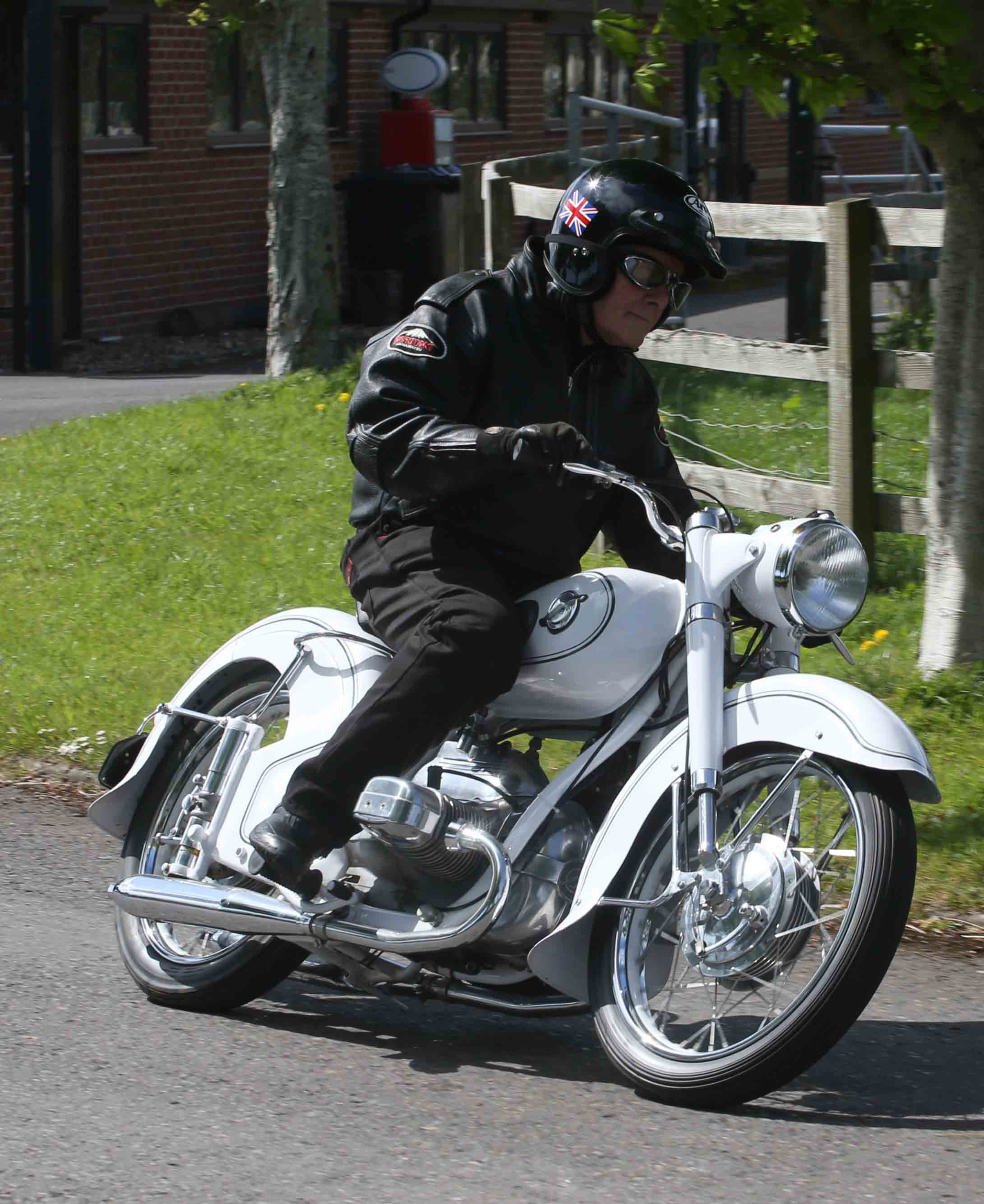
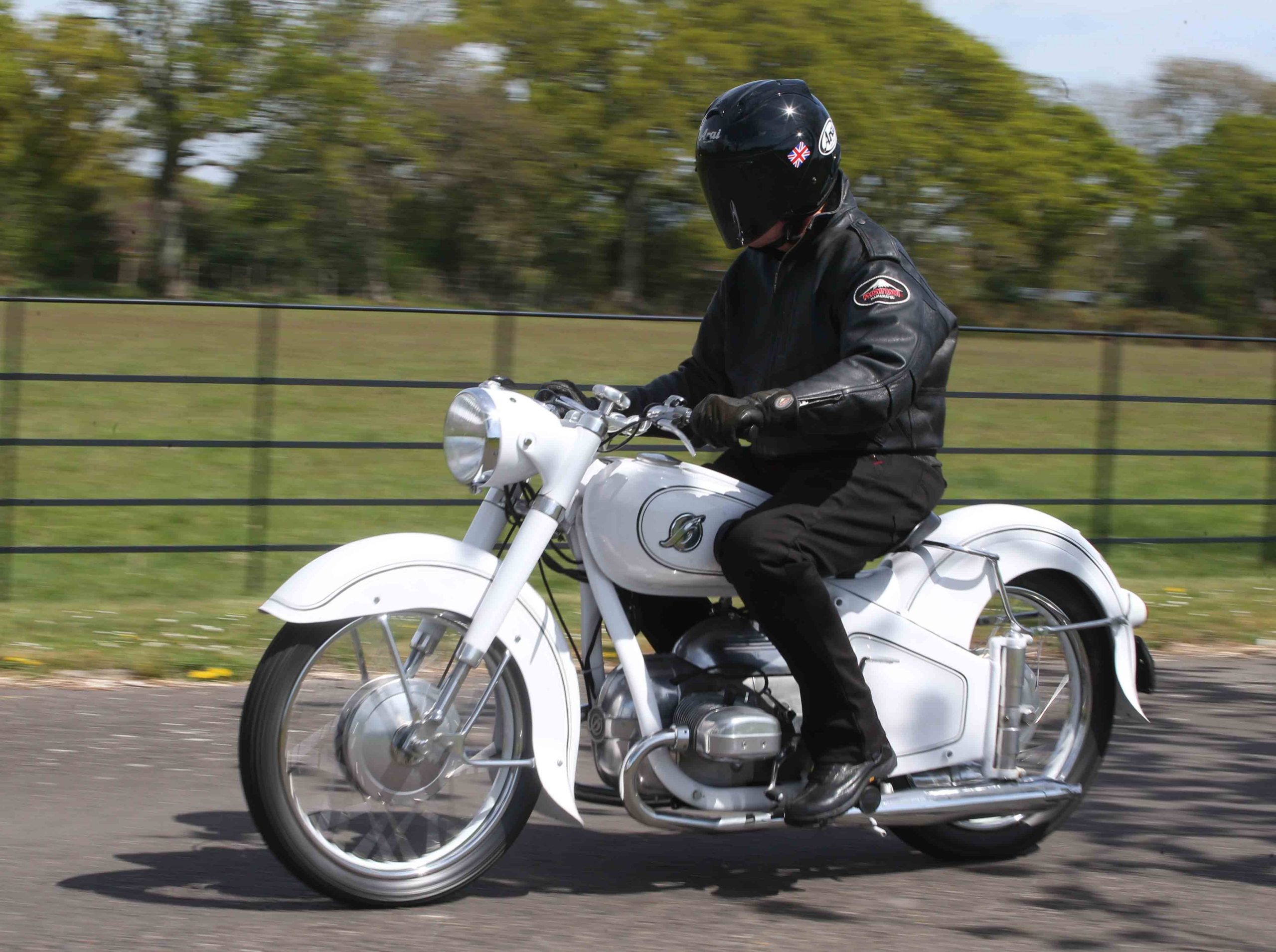
The crisply styled Hoffmann, with its deeply valanced mudguards, truly stands out in the German Corner of the Miller Museum. I was lucky enough to spend a day riding it through the scenic New Forest, and it proved to be a delightful surprise.
Firing up the Hoffmann Boxer is done in the time-honoured BMW manner: stand on the left, pull out the side-mounted kickstart lever, and give it an easy push. It bursts quietly into life. Hopping aboard, the broad single seat delivers a low and comfortable riding stance.
Power is transmitted to the shaft final drive via a car-type twin-plate dry clutch and a four-speed all-chain gearbox, a technical trademark of its designer, Richard Küchen. The gearshift is remarkably smooth in the higher three ratios, even more so than a conventional BMW of the era.
The throttle pickup is clean and responsive, and the Hoffmann belies its quarter-litre status in terms of acceleration. I found I could sit at 80 km/h all day long with almost no vibration. It felt like a solid, well-settled motorcycle. While the plunger rear end was pretty ineffective over ridges, the upside-down fork-of Hoffmann’s own manufacture-handled the bumps of the New Forest roads much more effectively.
The Hoffmann Gouverneur was a pleasant and unexpected surprise. It is a machine of high quality and solid engineering that surely deserved more than its brief season in the sun. In the end, it simply missed the boat by taking too long to enter production, becoming a beautiful footnote in the rich history of German motorcycling.
Hoffmann Gouverneur MP250-2: Under the Skin
A closer look at the specifications reveals a machine brimming with ambition and thoughtful engineering, a true reflection of the post-war German motorcycle industry’s aspirations.
At its heart lies an air-cooled, OHV horizontally-opposed twin-cylinder four-stroke engine, a layout famously championed by BMW but rarely seen in the 250cc class. With a short-stroke design measuring 58 x 47 mm, the “Baby Boxer” displaces a tidy 248cc. Fed by a single 24mm Bing carburettor and running a 7:1 compression ratio, the revised MP250-2 produced a respectable 14.5 bhp at 4,800 rpm. A 60W Noris magdyno provides the spark.
Designer Richard Küchen’s unique vision is evident in the transmission. Power is channelled through a dry twin-plate clutch to a 4-speed gearbox that unconventionally uses internal chains and sprockets, before reaching the rear wheel via a clean and reliable shaft final drive.
The chassis itself is a work of art, built around a pressed-steel spine frame complemented by oval-section tubular steel engine supports. The steering head and plunger boxes are beautifully crafted from cast aluminium. For suspension, the front features a 32mm Hoffmann-made inverted telescopic fork, a remarkably forward-thinking design for the era, with dual springs in each leg. At the rear, a pair of Hoffmann plunger units handle the bumps.
Rolling stock consists of 19-inch wire-spoked steel rims, with a 3.00 x 19 Dunlop tyre up front and a 3.25 x 19 Mitas at the back. A pair of 180mm single leading-shoe drum brakes are tasked with bringing the bike to a halt.
Tipping the scales at a substantial 150 kg dry, the Gouverneur is no lightweight. It stretches out over a 1350 mm wheelbase, and the comfortable single saddle sits at an accessible 735 mm. The 16-litre fuel tank promised decent range for exploring the newly rebuilt roads of Germany. While not a fire-breather, its claimed top speed of 112 km/h (70 mph) made it a capable machine for the time.
The specific 1953 model featured here is a treasured part of the collection at the Sammy Miller Museum in Hampshire, UK, a testament to a fascinating chapter of motorcycling history.
Nestled in New Milton, Hampshire, the Sammy Miller Museum is a treasure trove for motorcycle enthusiasts. Packed to the rafters with fascinating machines, it showcases everything from rare factory prototypes to ingenious designs from around the globe. Boasting one of the world’s most impressive collections of exotic racing bikes—all in running order—it’s a haven for lovers of two-wheeled history. Marvel at legends like the V8 Moto Guzzi 500, the supercharged V4 AJS 500, and the postwar Porcupine—the first-ever 500cc World Champion. The lineup continues with the V-twin Husqvarna 500, V4 Suzuki 125, 250 Mondial with its iconic dustbin fairing, and countless classics from Triumph, Norton, AJS, Velocette, and more. Off-road fans won’t be disappointed either, with a dazzling array of enduro, motocross, and trials icons on display.
Open daily from 10am year-round, the museum is a must-visit for anyone with a passion for motorcycles. You’ll find it at Sammy Miller Motorcycle Museum Trust, Bashley, New Milton, Hampshire B25 5SZ. For more details, call 01425 620777/616644 or visit www.sammymiller.co.uk.