From our Old Bike Archives – Issue 101 – first published in 2022.
Story: Jim Scaysbrook • Photos: Elwyn Roberts and Jim Scaysbrook
Originally conceived to take on the perilous public road events in Italy, the Corsa C 4V is an out-and-out racer in the classic mould.
To say that Mike Coates likes his Guzzis would be a gross understatement; his collection is mouth-watering and eclectic, with an emphasis on the 80/90s models. In reality, Mike’s stable starts from the very beginning – a 1921 Normale from the company’s very first year of production – up to comparatively recent examples of both road bikes and racers.
One of the real standouts is another thoroughbred from Guzzi’s fledgling days, a beautiful example of the 500cc 4-valve competition machine from 1926. Here is a motorcycle that is every inch a racer, with not a gram of unnecessary material, built for one purpose – to go as fast as possible for very long distances. Because in the 1920s, Italy was home to some of the most famous – and most punishing – events ever devised. Epic public road blasts between towns and cities that were a test of navigation and avoidance of hazards as much as outright speed and reliability. There were also a limited number of closed circuit events. In Italy this initially meant just the Monza track in the Royal Park north of Milan which opened in 1922 – only the third purpose-built racing circuit after Brooklands (UK) and Indianapolis (USA).
While Carlo Guzzi was determined to concentrate on getting consumer machines into dealers, his partner Giorgio Parodi was equally determined to go racing, arguing that racing success was the key to showroom sales. Ironically, it was Guzzi who had designed and built a pair of prototype racers in 1919 – two years before production began at the Moto Guzzi factory. The fuel tank carried the motif GP, for Guzzi-Parodi. This machine was very advanced for the day, with single overhead camshaft, four valves in the head, bore and stroke of 88mm x 82mm, unit engine/gearbox construction, geared primary drive and chain rear drive. The over-square dimensions provided a lower piston speed and greater volumetric efficiency, while the four inclined valves contributed to superior breathing. Lubrication was controlled by a gear-type oil pump driven from the right hand end of the crankshaft. Placing the large 300mm flywheel on the exterior produced a much smaller crankcase. Ignition came from a magneto mounted on top of the engine. With 17hp on tap, top speed was around 130km/h. This made many of its contemporaries, using side-valve, long stroke engines with belt drive look rather ancient in comparison.
Track time
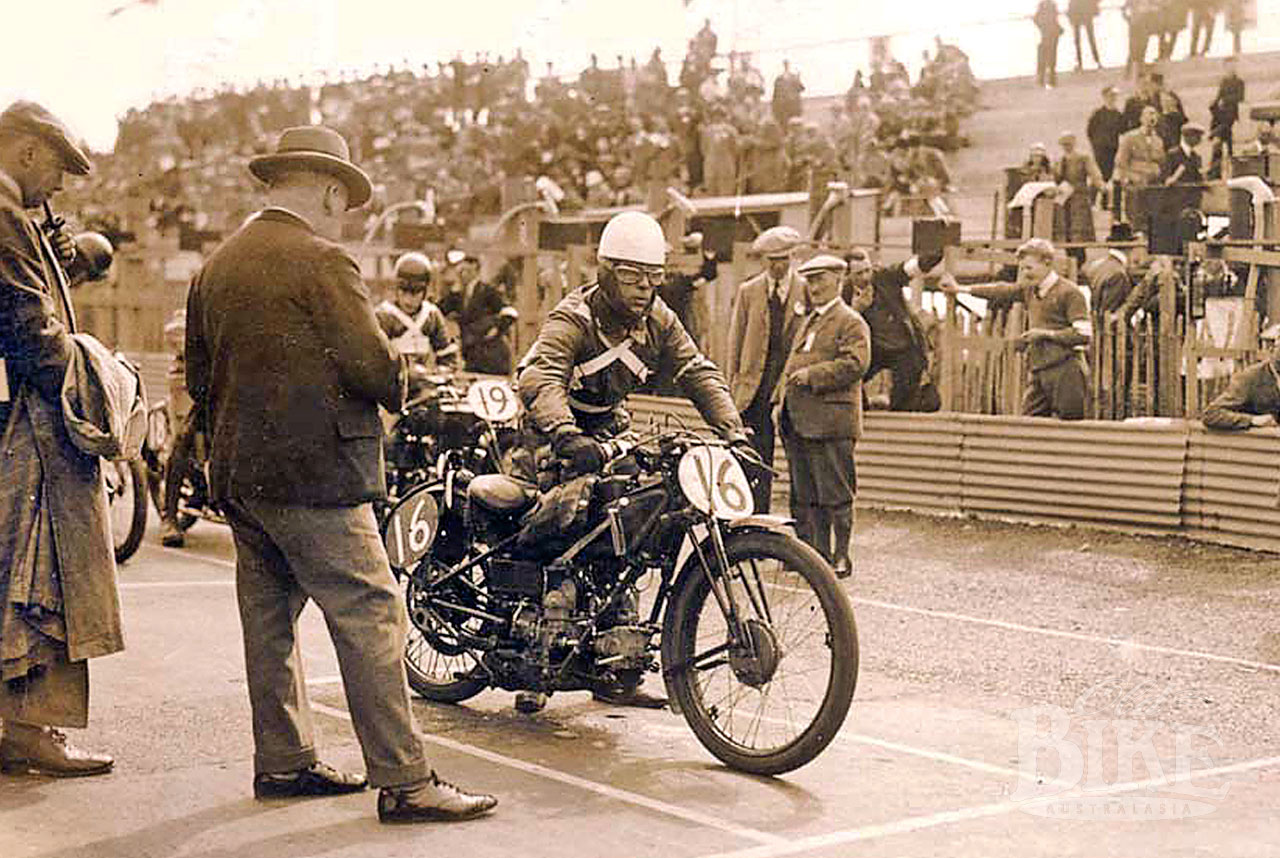
Eventually, Parodi won out, convincing Carlo to allow the two prototypes to enter the Milano-Napoli race in 1922. It was an unspectacular debut, but both at least finished the punishing event, and just four weeks later, Gino Finzi scored Moto Guzzi’s first victory in the Targo Florio, held around the island of Sicily. This encouraged Carol Guzzi to commence limited production of the C 2V in Corsa (racing) form, but in the interests of economy, the overhead camshaft, four-valve head was dropped in favour of a two-valve pushrod layout, producing 17hp at 4,200 rpm. The C 2V was a relatively simple, but effective design that was far cheaper to produce, and was also the first Moto Guzzi to be finished in red. The cylinder head had the pair of 45mm valves inclined at a narrow angle, operated by exposed pushrods, with a compression ratio of 5.25:1 and a 1 inch Amac carburettor (later replaced by a 25mm Dell’Orto). Top speed was stated as 120km/h.
The racing C 2V made its debut in the 1923 Giro d’Italia, ridden by Carlo Guzzi’s brother-in-law Valentino Gatti, and it later competed in the torturous Circuito de Lario, a 40km lap around Lake Como, running straight past the Moto Guzzi factory. Also in 1923, Guido Mentasi won the Milan to Naples race on a 500cc Frera, built at Tradate, not far from the Moto Guzzi base of Mandello del Lario, and was promptly signed up by Guzzi. On his debut for his new team Mentasi won the 1924 2,500km Giro d’Italia on a C 2V.
Chasing the crown
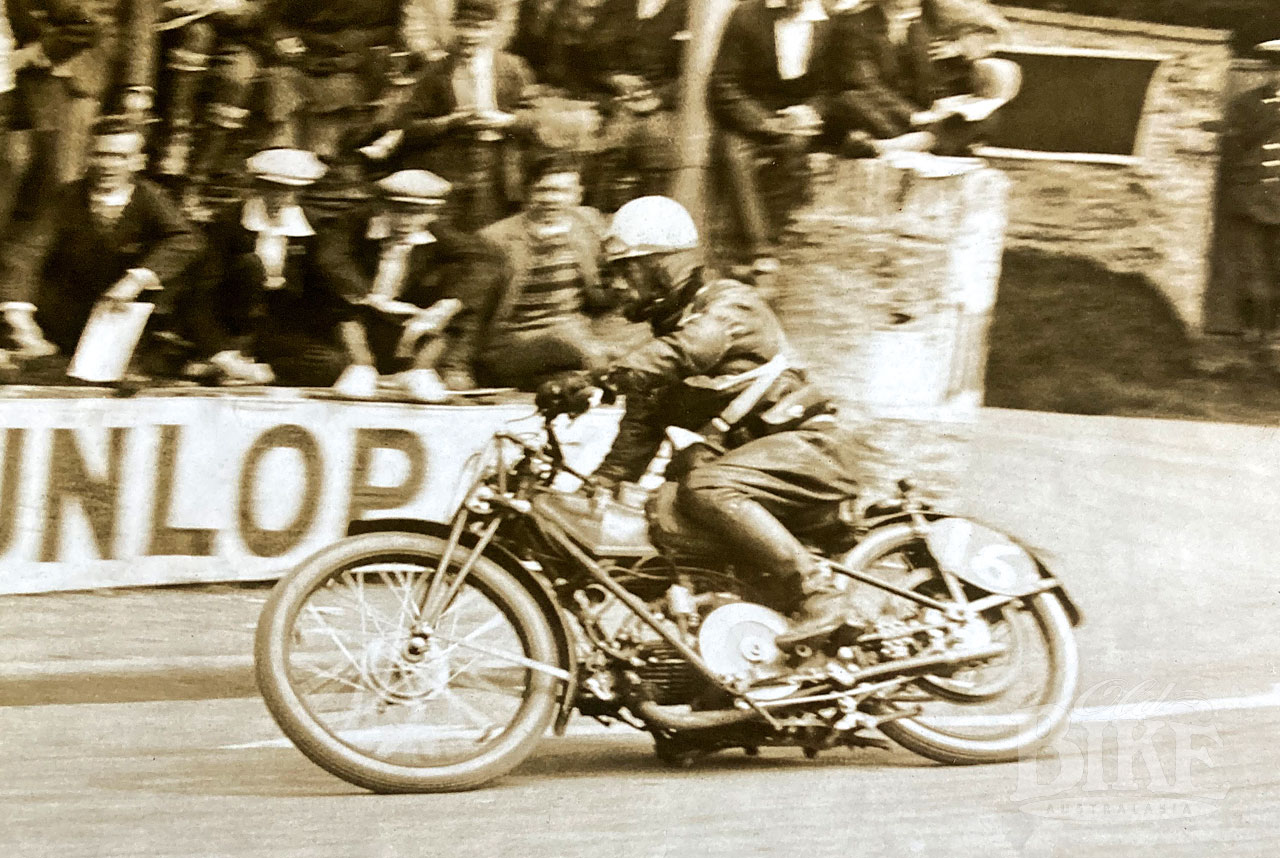
It was in 1924 that an official European Championship was instigated by the FICM, initially in 250cc, 350cc and 500cc categories, attracting entries from many countries, including Great Britain. The championship was to be decided over a single race event to be held at Monza in September, and Guzzi decided that the C 2V was struggling for pace against an ever-improving opposition, and took the brave decision to produce the C 4V four-valve model as a works machine, while the C 2V was made available as a production racer available to the general public – but painted green. With a few updates, including twin ignition and in 1931, a frame with rear suspension, the C 2V remained in production until 1930, when it was replaced by the 2VT.
The new C 4V was in fact a reversion to the basic design of the 1919 prototype, and it made a victorious debut in the 1924 Lario event – by now referred to as the Italian ‘TT’ with dozens of corners, steep climbs and sheer drops– ridden by Pietro Ghersi. Even more significantly, Ghersi soon after scored the factory’s first major win outside Italy when he took out the German Grand Prix at the ultra-high speed AVUS circuit in Berlin. Then came the icing on the cake, when Mentasi became European 500cc Champion after winning at Monza.
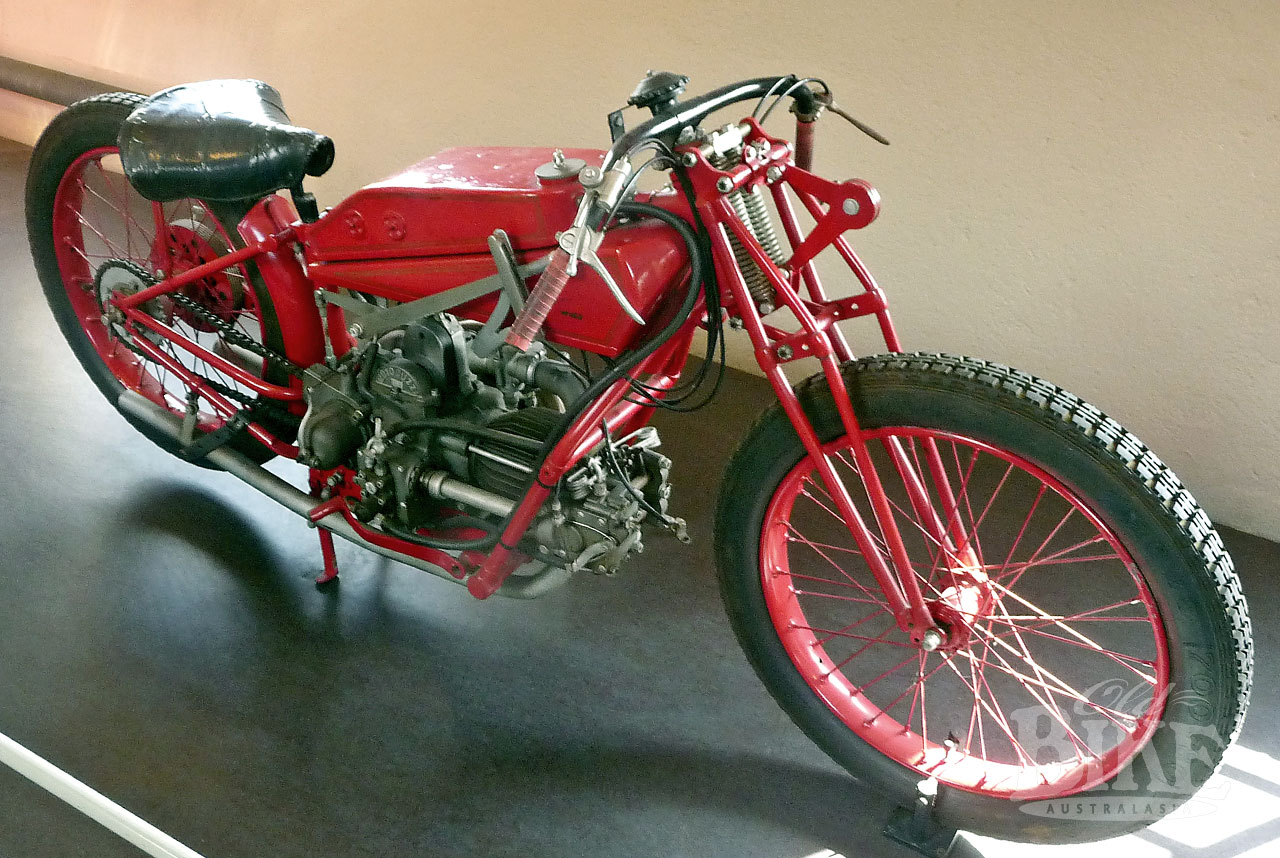
The factory quickly sought to capitalise on these successes by offering a customer version of the C 4V. In original form, the 1924 C 4V poked out 22hp at 5,500 rpm with an iron head and barrel. The valves were inclined and the overhead camshaft set at an angle due to the top end of the motor being slightly offset. Subsequently developed into the 4V TT (produced from 1927 to 1929) and the 4V SS (1928-1933), power increased steadily to 32hp. Unfortunately, although the engine was an excellent performer, the chassis basically remained in its original form and became quite antiquated. Similarly, while foot-change positive stop four-speed gearboxes were rapidly catching on, the C 4V and its derivatives stuck with a three-speed hand change. And despite the fact that other models in the range had spring frames from 1928, the C 4V’s frame remained in rigid form throughout its 10-year lifespan. A total of 486 units, across the three variants, were built up to 1934.
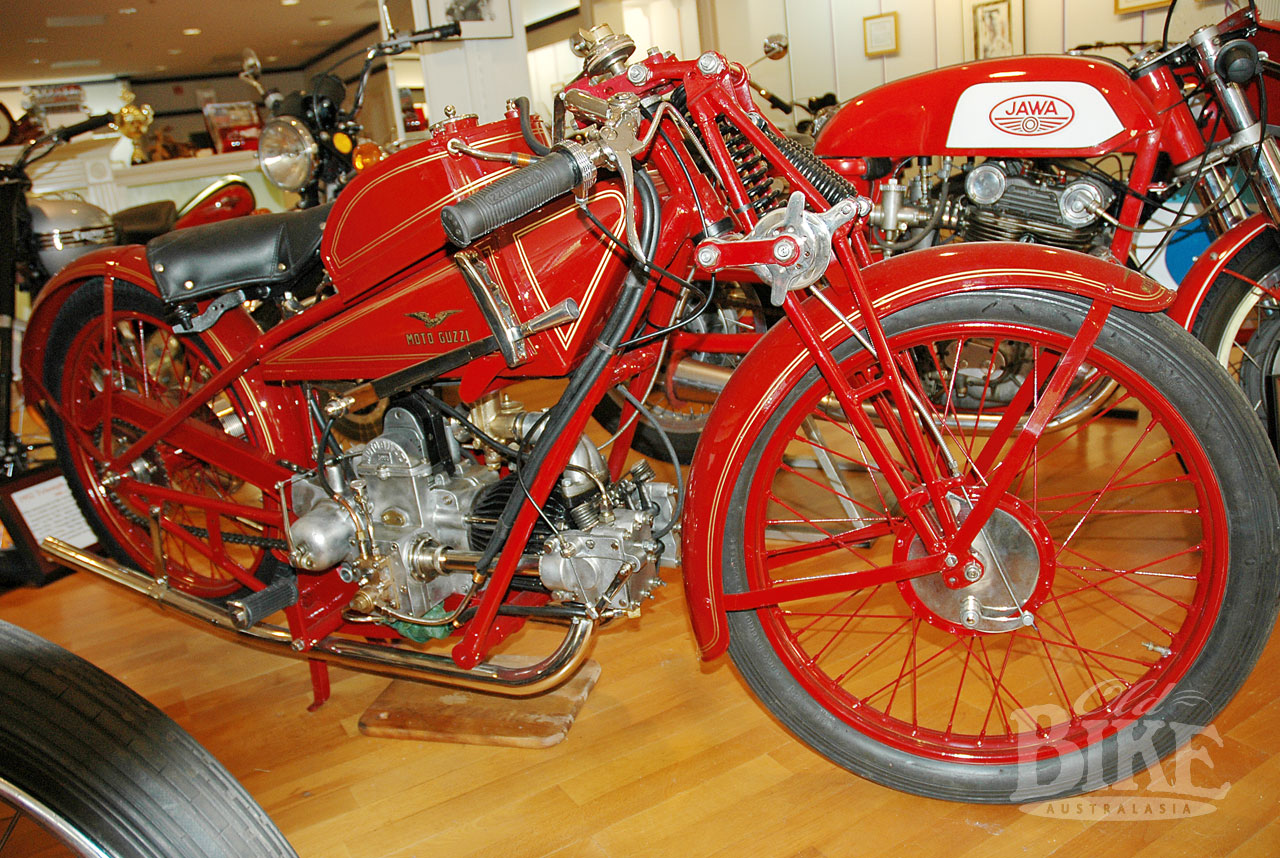
Mentasi’s 1924 500cc European Championship remains Moto Guzzi’s sole pre-war success as the British marques took over, although Omobono Tenni did take out the 250cc Championship in 1937. Moto Guzzi’s answer (after a dalliance with a complex supercharged four cylinder Grand Prix machine in 1930) was to abandon the ageing single in favour of a new model – the 1933 Bicilindrica with a 120-degree v-twin engine which initially remained in the rigid frame. Like the C 4V, the Bicilindrica was steadily developed for more power and better handling with a new spring frame where the rear suspension could be adjusted on the move via a hand control on the left side. In this form, the twin, in the hands of Irish maestro Stanley Woods, went on to win the 1935 Isle of Man Senior TT, just days after he had won the Lightweight TT on the 250cc Moto Guzzi – the first Isle of Man victory for an Italian machine.
A survivor
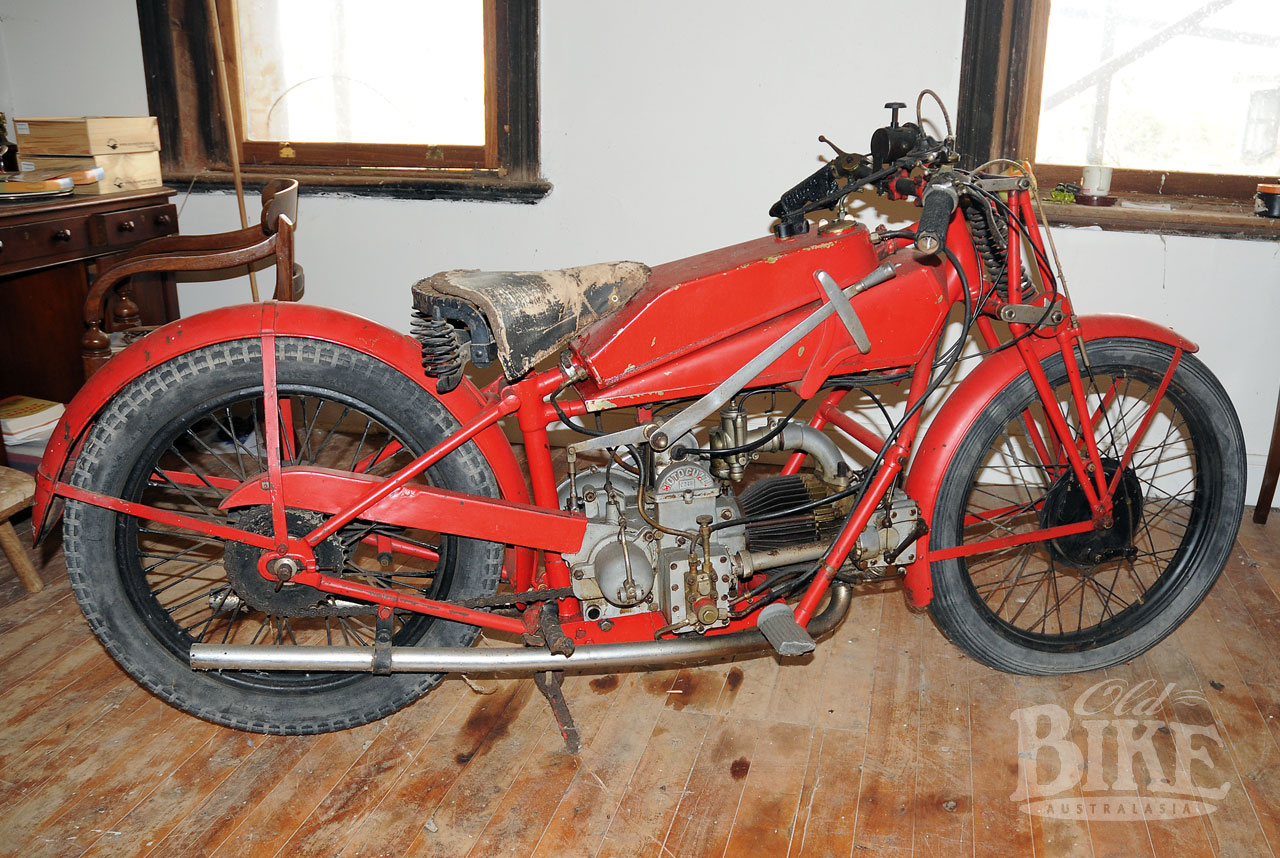
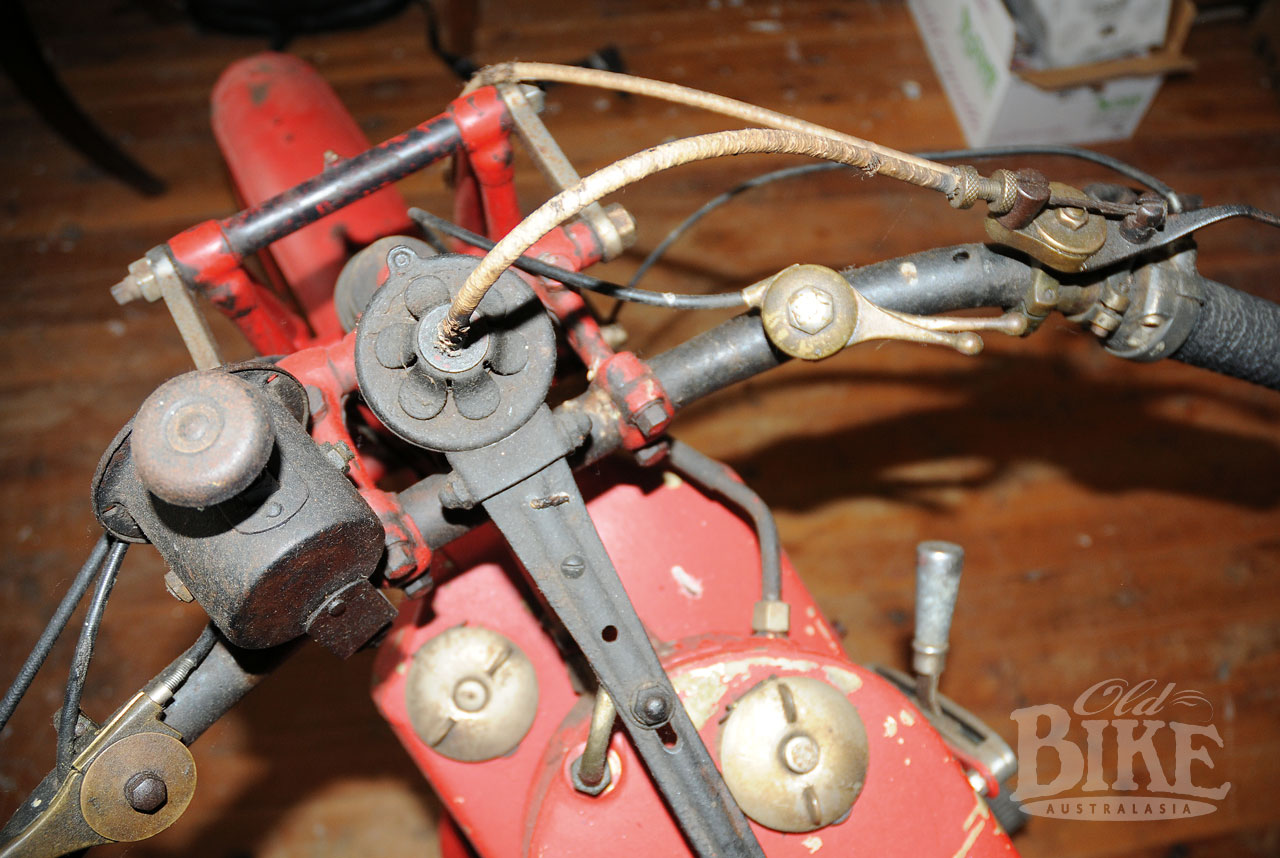
Understandably, because only 486 were built in the three variations (C 4V, 4V TT and 4V SS) there are few examples of the C 4V left, almost a century after they first saw the light of day. Also surprisingly, there are thought to be four in Australia. Because the customer C 4Vs could be ordered in various specifications according to the intended use, each one is subtly different. In the case of brakes, for example, some were supplied with only a rear brake, others, such as this one, used a small diameter drum front brake, while others employed a stirrup-type brake with a friction wedge pad running in a channel as used on some British machines. Others were ordered with a friction steering damper atop the steering column, controlled by a lever above the right-side twist grip. One such example has been owned for many years by Steve Hazelton, formerly the editor and publisher of Classic Motorcycling Australia magazine and a long-time purveyor of rare and historic motorcycles in Australia.
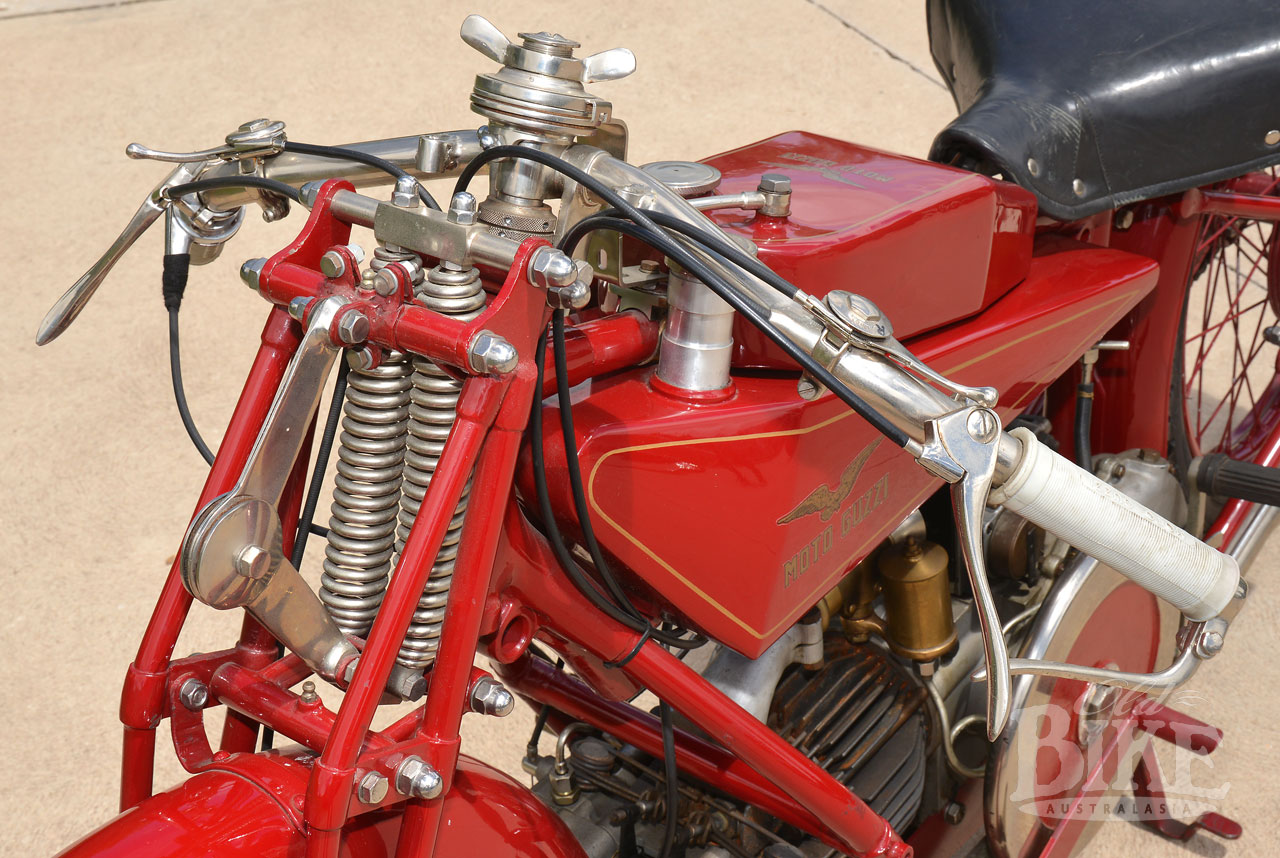
Like many of the competition Moto Guzzis, the oil tank sits atop the petrol tank, some incorporating a chain oiler. Some had the footrests positioned well forward, bolted to the ends of the front down tubes, while others had them further back, beneath the gearbox on the right side and behind the flywheel on the left.
Mike’s C 4V was purchased from a private collection in Europe and arrived in Australia in 2020. An older restoration, it is nonetheless a striking looking machine in the correct specification for 1926, with the possible exception of the front brake. The engine features the iron head and barrel that was normal for pre-war when alcohol-type fuels could be used. The huge 300mm outside flywheel dominates the left hand side of the machine, with the rear brake lever sitting across it. The seat is an English Terry, although Lycett saddles were also used on the C 4V models.


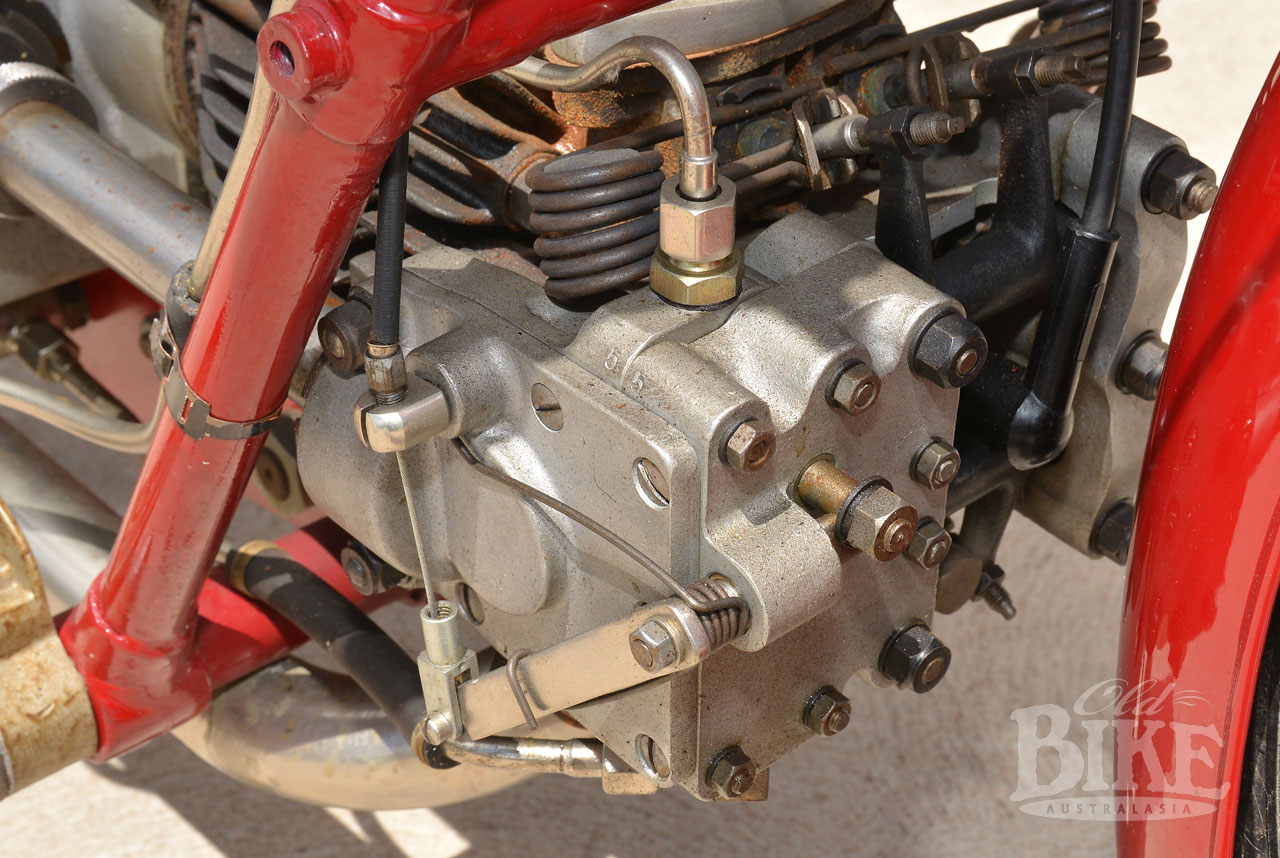
“The factory would configure the C 4V to how each customer wanted it,” says Mike. “For instance there are lots of different brake configurations depending on what type of event they were racing. Steve Hazelton has another C 4V (unrestored), which is much the same but it has a remote steering damper that comes over near the tank and is operated by a lever on the right side. I’d love a Bicilindrica (120-degree v-twin 500cc racer) but they are pretty hard to come by.”
As it approaches its centenary, the C 4V sits imperious in Mike’s collection. Long gone are the days when it bored through Italian villages, aiming to reach a far-flung destination seconds faster than the opposition, particularly opposition from rival factories. Perhaps its stomping ground was the majestic royal park of Monza, or occasional sorties to unfamiliar tracks in unfamiliar countries. Whatever the truth, the C 4V has earned its retirement, and in its new home, surrounded by brethren from Mandello del Lario; everything from humble 75cc two strokes to the modern big bore v-twins that continued Moto Guzzi’s tradition of triumph at the track. I also get the feeling that sooner or later, Mike will find a Bicilindrica to make his collection even more special and unique.
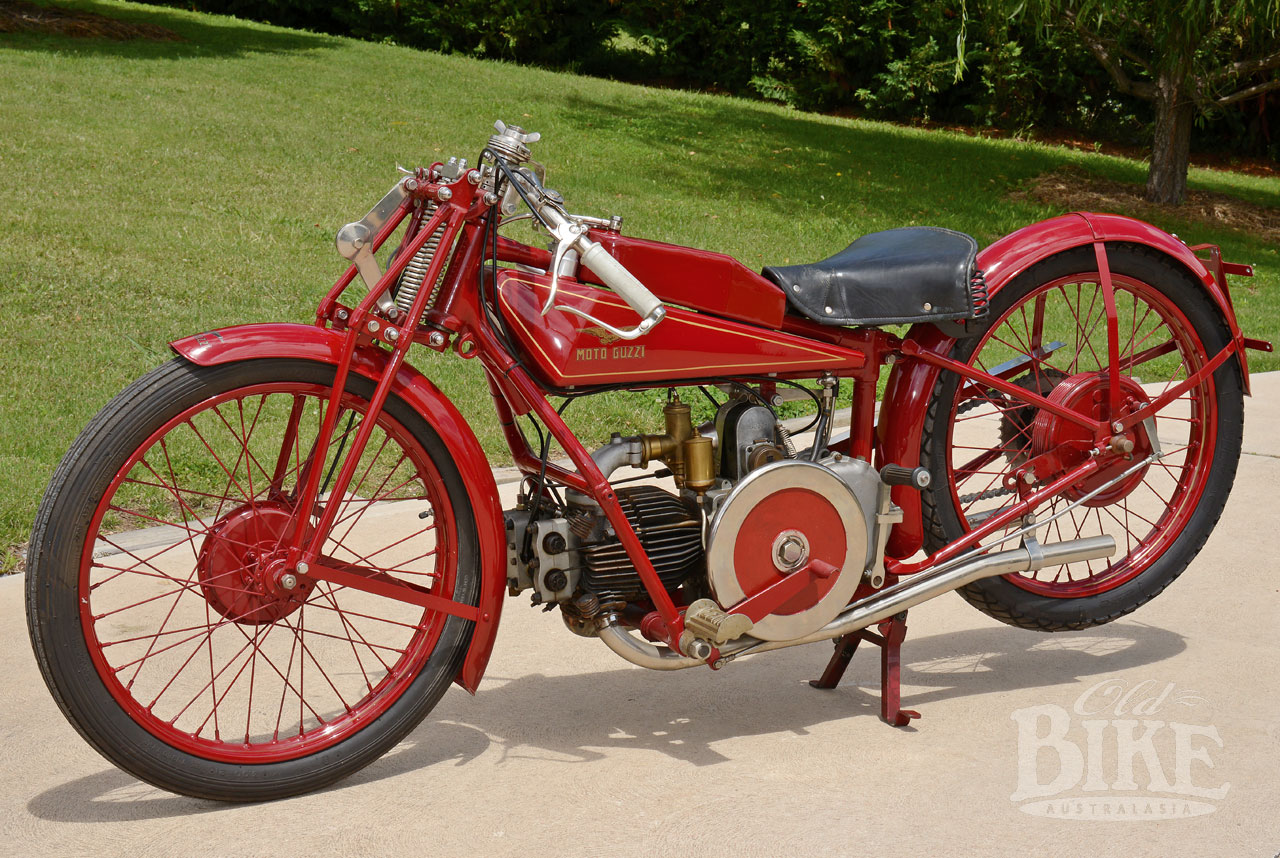
Specifications: 1926 Moto Guzzi C 4V
Engine: Single cylinder, single overhead camshaft, 4 valves.
Compression ratio: 6.0:1
Power output: 22hp at 5,500rpm
Cylinder head: Cast iron
Cylinder: Cast iron
Ignition: Bosch magneto
Carburettor: AMAC
Lubrication: Geared pressure pump, vaned scavenge pump
Clutch: Wet multi-plate.
Gearbox: 3 speed, hand change
Transmission: Primary: spur gear. Final: Chain
Frame: Tubular steel duplex cradle
Wheelbase: 1380mm
Suspension: Front: Girder fork with two springs and friction dampers
Rear: Rigid
Wheels/tyres: 3.00 x 21 inch
Weight: 130kg
Top speed: 150km/h
Fuel capacity: 10 litres
Oil capacity: 4 litres.