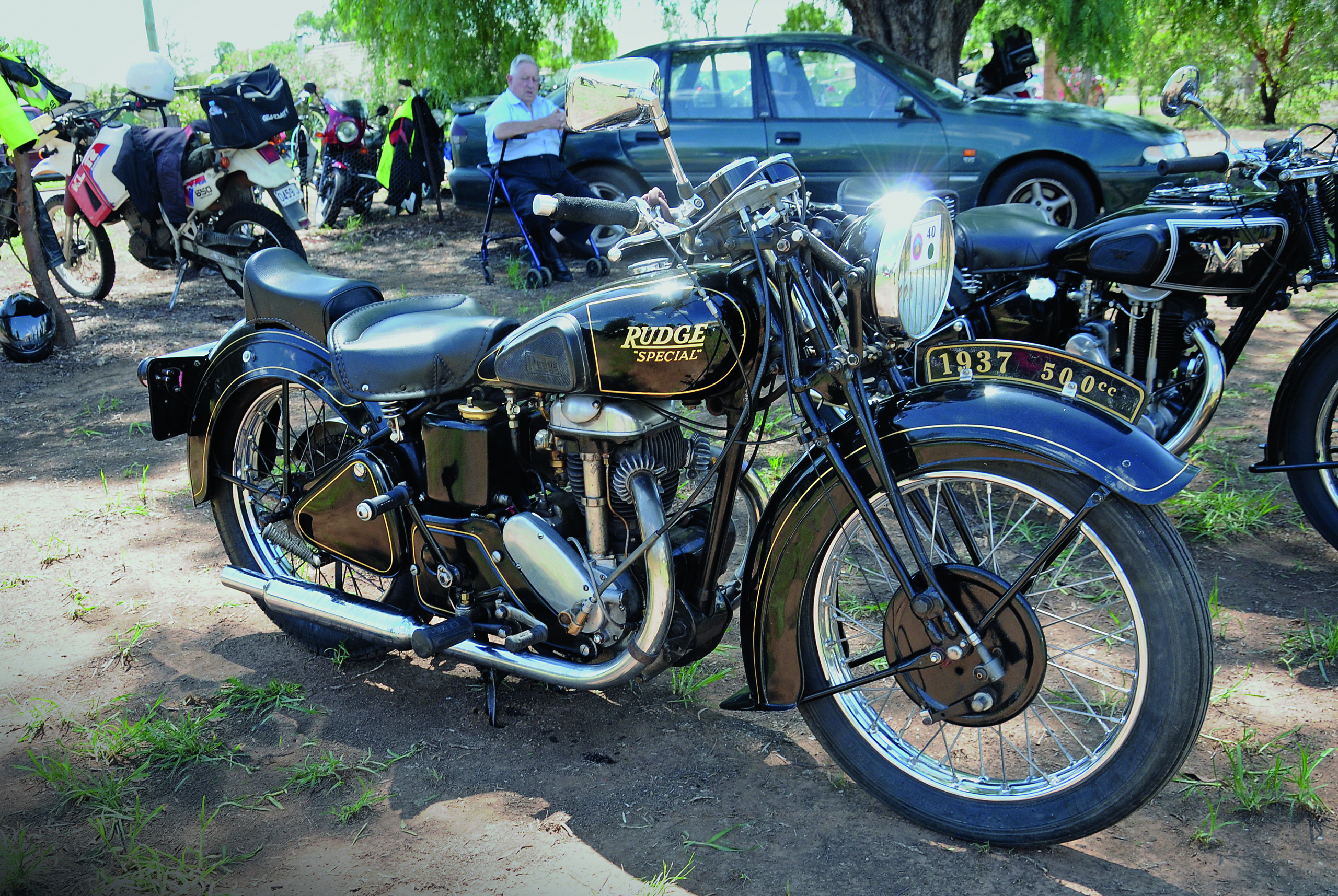
OBA 126 Rudge Special 1937. Story and photos by Jim Scaysbrook
Rescued from a fate worse than death, a Rudge Special now struts its stuff again.
For a company that produced motorcycles for only thirty years, Rudge carved out an enviable reputation. Innovation, quality, finish, performance and racing success were terms that well described the company’s products.

In motorcycling terms, Rudge-Whitworth has often been referred to as “probably the saddest casualty of World War II”. The war delivered the final blow for the company that began back in 1868 in Wolverhampton, where Dan Rudge had begun building Velocipedes, the forerunner of the bicycle. Dan was a clever bloke, and had soon patented a number of features including axles running on ball bearings, and by the time he passed away in 1880 he had built up a successful business behind the Tiger’s Head Inn, where he was the licensee.
The Velocipede business was sold by Dan’s widow to a rival, George Woodcock, who had interests in several other bicycle companies, and who merged all of these into the “D. Rudge and Company and the Coventry Tricycle Company”. By 1885 this had been sensibly shortened to just D. Rudge and Company Ltd. Woodcock died soon afterward and the company, which, like many bicycle firms, was by now struggling in a saturated market, was sold to Charles Pugh, supplier of bicycle components in Birmingham. The new entity became the Whitworth Cycle Company, and in 1894, Rudge-Whitworth Ltd was formed. It was not until 1911 however that Rudge-Whitworth produced their own motorcycle, a 499cc single with inlet-over-exhaust valve layout.
The new machine was an instant success, with Victor Surridge piloting one at Brooklands to set up the first ever one hour run by a 500cc motorcycle at over six miles per hour. Up to this point all Rudges had been single-speed, but a major development came in the form of a variable speed pulley system which became known as the Rudge Multi gear. A profitable sideline for the company was the manufacturer of wire-spoked wheels for the motorcycle and car trades as well as the mining industry.
Rudge became stalwarts of the annual TT races in the Isle of Man and in 1914 Cyril Pullin won the blue-ribbon Senior event at an average of 49.5mph. But storm clouds were gathering as Europe went to war, and motorcycle production was set aside as Rudge worked flat out to build bicycles for the British, French, Belgian and Russian armies. It was 1919 before motorcycle production resumed in earnest, with a 998cc V-twin in the line up. With the rapid advancements in motorcycle gearboxes, the Multi was now out-dated and John Pugh designed a three-speed transmission for 1920, with an all-chain drive in the following year.
In the face of stiff competition from other manufacturers, Rudge needed a shot in the arm, which came when the old inlet-over-exhaust valve engine was replaced with a 350cc, and soon after, a 500, with a four-valve cylinder head and a four-speed gearbox. The switch to four valves was not just in the interest of chasing power via enhanced gas flow. The metallurgy of the day dictated that the large holes required by a conventional inlet and exhaust valve could have the potential to weaken the entire structure and lead to cracking. Four smaller holes, on the other hand, would be far less stressful – a theory proven by the advanced Triumph-Ricardo four-valve design. Typically, Rudge’s four-valve was the source of constant development to improve the shape and efficiency of the combustion chamber.
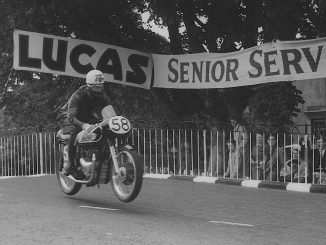
This had the immediate effect of doubling the factory’s motorcycle output in 1924 over the previous year. In 1926, Rudge returned to full-scale racing with four-valve models that were remarkably similar to the road-going versions. After narrowly losing the 1928 Senior TT after a big end failed when he was leading on the last lap, Rudge Sales Manager and talented racer Graham Walker (father of future commentator Murray Walker) won the Ulster Grand Prix at an average of 80.078 mph – the first road race to be won with an over 80mph average. The factory responded to what was quickly termed “The World’s Fastest Road race” by bringing out a commemorative model. Thus was born the Rudge Ulster.
The factory Rudges won four more of the Classic road races in 1929, and also dominated in the new-fangled sport that had arrived from Australia – dirt track Speedway. Previously, the Rudge 4-valve engines had been “pent roof” with the inlet and exhaust valves arranged in parallel pairs, but this was not considered the optimum for the most efficient cylinder filling and combustion. The result was a new ‘Radial’ design that used just two pushrods and a chain of rockers across the top of the cylinder head. Three of the new Radial engines were ready for the 1930 Junior TT, and the team scored a sensational 1-2-3. In 1931, Waker finally added his name to the TT winners list with victory in the Lightweight on the 250 Rudge.
That resounding success should have been a windfall for Rudge, but it coincided squarely with the Great Depression, flattening the motor trade as well as most others. To make ends meet, Rudge went into the proprietary engine business, offering 175, 250, 350 and 500cc engines under the Python brand. It was a successful move, with a number of British and European manufacturers becoming customers.
One unlikely customer was none other than Enzo Ferrari in Modena, Italy. He had formed his own racing team, Scuderia Ferrari, with the aim of using Alfa Romeo P3 cars, but when this plan fell though he decided to utilize his team, complete with its mechanics and several former motorcycle racers who had been hired as drivers. Using 250, 350 and 500cc Rudges, Scuderia Ferrari began the 1932 European season and was quite successful, but when Rudge pulled out of racing in 1933, Ferrari was advised that supply of parts could no longer be guaranteed. He therefore reverted to his original aim of racing Alfa Romeos, which he did in 1934.
After a seemingly never-ending struggle, Rudge had to admit defeat in March 1933 when an official receiver was appointed. The fabled racing department was closed down at the same time, although a number of the ex-works bikes were raced in 1933 and 1934 in a private team run by Graham Walker. The receiver, to his credit, tried to return the company to economic viability rather than place it in receivership, but when John Pugh died in 1936, ownership of the company was taken by Gramaphone Company Ltd, who traded under the HMV brand. Rather than the usual asset-stripping, HMV tried very hard to make a go of Rudge, and instigated small improvements such as totally enclosed valve gear. But it was a losing battle, and HMV (by now known as EMI) moved Rudge into a smaller factory at Hayes in 1938. Ambitious plans were announced for 1939, including an all-new 350cc overhead camshaft engine. A new moped, known as the Autocycle and powered by a 98cc Villiers engine, also appeared in the model list. Then, once again, war intervened.
This time, there was no next chapter, and the manufacturing rights to Rudge motorcycles went to Raleigh, who already owned Rudge bicycles. Rudge closed on 26th July, 1939, by which time around 1,300 motorcycles had been built in the calendar year. A further 130 dribbled out of the factory by year’s end. Ironically, forward orders were healthier in 1939 than they had been for several years, but the capital to acquire and/or manufacture components was not there.
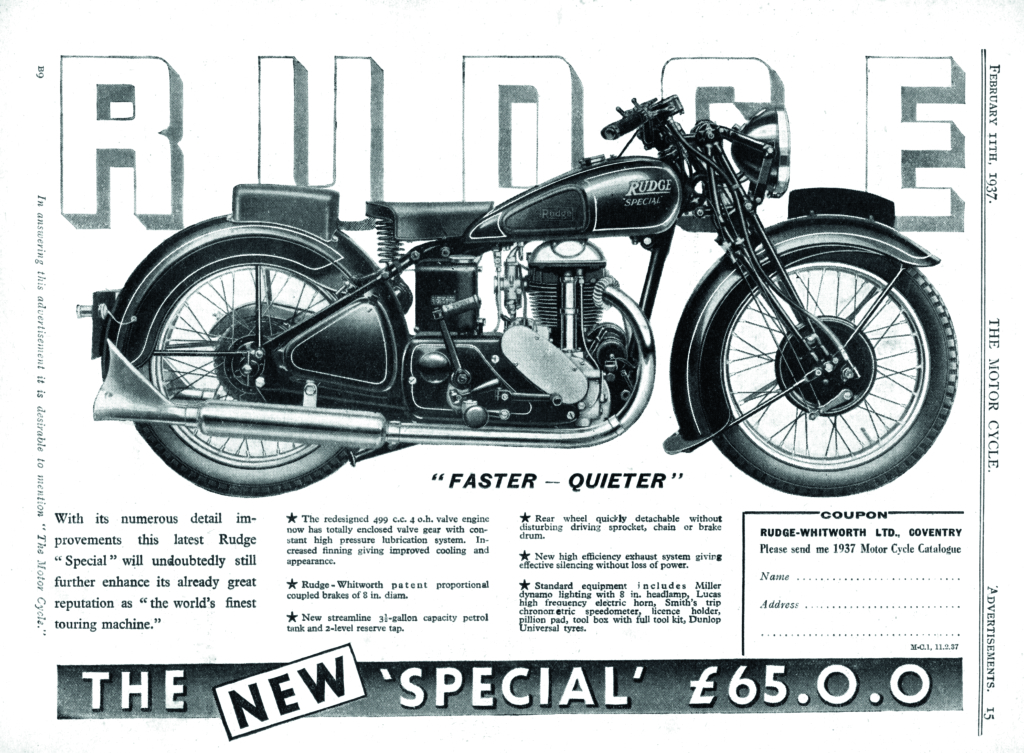
Something Special
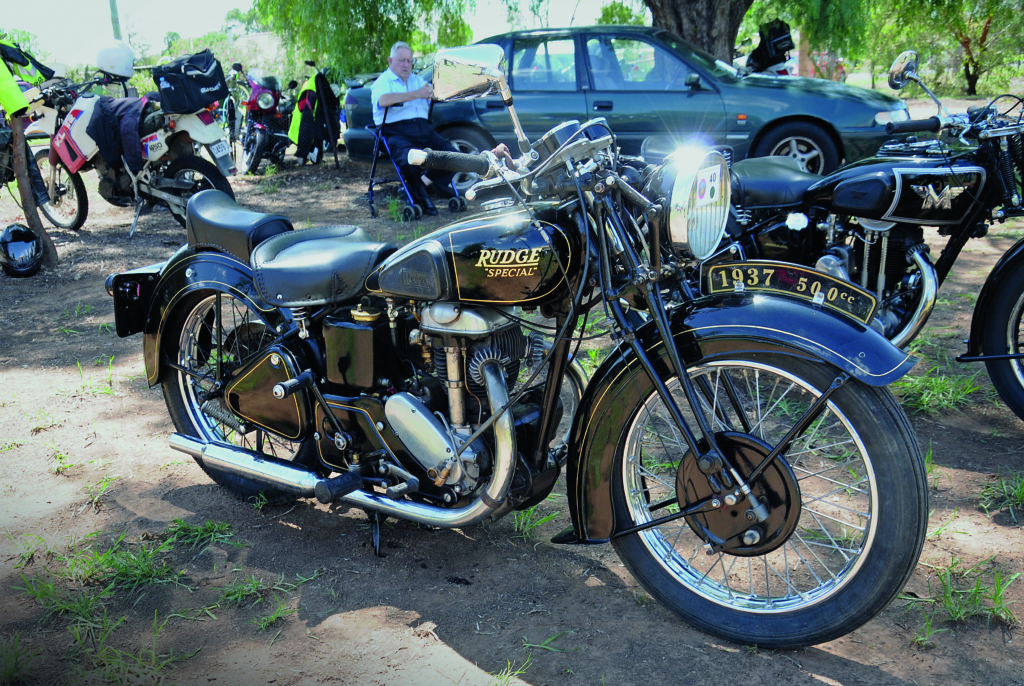
Introduced in the European winter of 1927/28, the Special was one of three 500cc models – the base model in fact of the group that also included the Sports and the Ulster. In essence an uprated version of the existing standard model, the Special received a restyled fuel tank, an Andre steering damper, and an extra helping of nickel plating. The engine mirrored the Ulster with bore and stroke of 85mm x 88m and fully enclosed roller bearing rocker gear and a four-speed gearbox. The Special used the “pent roof” four-valve head rather than the complex and costly radial valve arrangement on the Ulster.
Through the following decade, the Special received detail changes. Wheels were quickly detachable and interchangeable. A 350cc model was also offered and was virtually identical except for smaller, conventional brakes. In 1937 the Special’s foot-change gearbox had the operation moved from the left (unusual for a British motorcycle) to the right. It was said that the left-side foot change had come into being to suit Graham Walker, who had a bung right foot as a result of a WW1 injury. Also in 1937, the valve gear was completely enclosed in an aluminium alloy cover, with a better supply of lubricant to give the valve gear (and the cams at the base of the pushrod tubes) an easier life. Every engine was bench tested and stripped for inspection before being road tested.
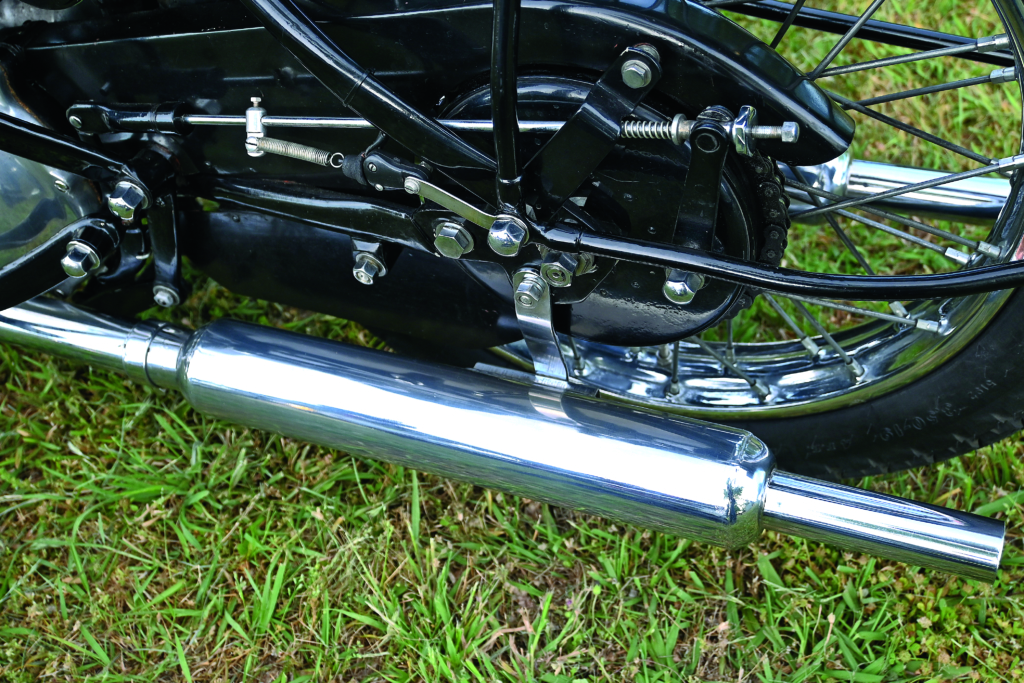
The prominent lever on the left side (designed by John Pugh) operates the centre stand and can be used without the rider dismounting. The rear mudguard was easily detachable by a set of wing nuts to permit quick removal of the rear wheel, leaving the chain and brake adjustment in place. Both wheels used the patented Rudge double-butted spokes and rims. Brakes were something that Rudge had always thought long and hard about – there was even a six-shoe design that was abandoned because it was not only too complex to assemble and maintain, it was also too powerful for conventional spokes and rim in the front wheel. Rudge’s unique spoke pattern placed the big wide drum more centrally in the wheel.
The linked brakes were another Rudge quirk. This was achieved by having an extra cable running from the rear brake lever to the operating lever for the front cam. The rear brake pedal could therefore be used to operate both brakes simultaneously or the front brake alone by handlebar lever. In effect, the system was less than perfect and many owners chose to adopt the simple process of converting the brakes to individual operation.
Temptation knocks
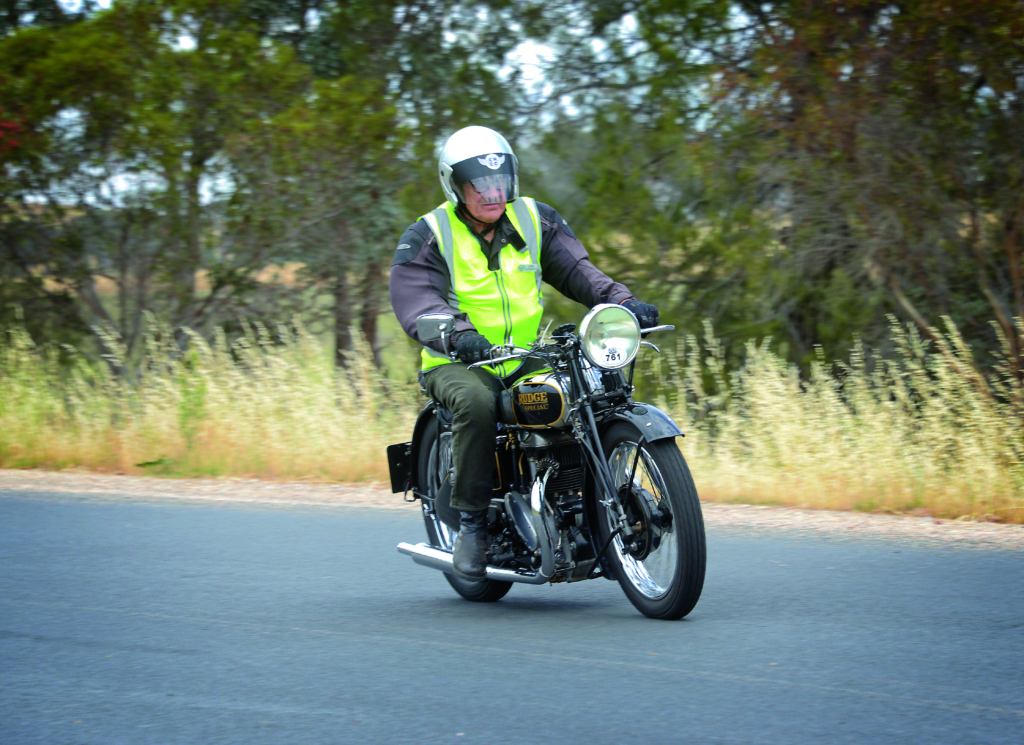
The 1937 Rudge Special featured here is owned by Mark Loiterton, a former Short Circuit rider and today one of the driving forces behind the motorcycle side of the Cootamundra Antique Motor Club (CAMC) and the popular annual rally.
His acquisition of the Rudge came about following the death of its owner, Peter Gaggioni, who was a well-known enthusiast from Wangaratta, Victoria who passed away in January 2024, aged 96. Noel James (whose Triumph 6/1 twin was featured in OBA 93) knew Peter Gaggioni well and was appointed executor of the estate. Amongst Peter’s impressive stable were two Rudges – the Special, plus an Ulster, also from 1937. The blue Ulster with its aluminium bronze head was rebuilt by Peter Gaggioni over a thirteen-year period, being completed in 1993. Together with fellow CAMC member Don Goodwin and his grandson Matty, Mark formed a plan to keep the Rudges together by a combined purchase to secure both. Mark kept the Special while the Ulster went to Don, with Matty becoming its regular rider in classic rallies. The Goodwin family, also from Cootamundra, is a real motorcycling dynasty, from Don, now aged 93, to his sons Graham and Peter, and Peter’s son Matty.
Mark received a small amount of material with the Special, including some photographs of how it was originally found many years ago by Peter Gaggioni – as a flogged-out wreck that had spent its last days being thrashed around country Short Circuit tracks. Clearly, most of the major components – engine/gearbox, frame forks and wheels – were there but in sad shape, but tricky stuff like mudguards and brackets, the original oil tank, tool box and their special decorative covers, seat and luggage rack were long gone. This meant a long process of rectification and fabrication by Peter Gaggioni, who fortunately was highly skilled in this area and did an excellent job, who also made the battery cover, gearbox skirt, and gear lever, all of which have his initials proudly stamped into.
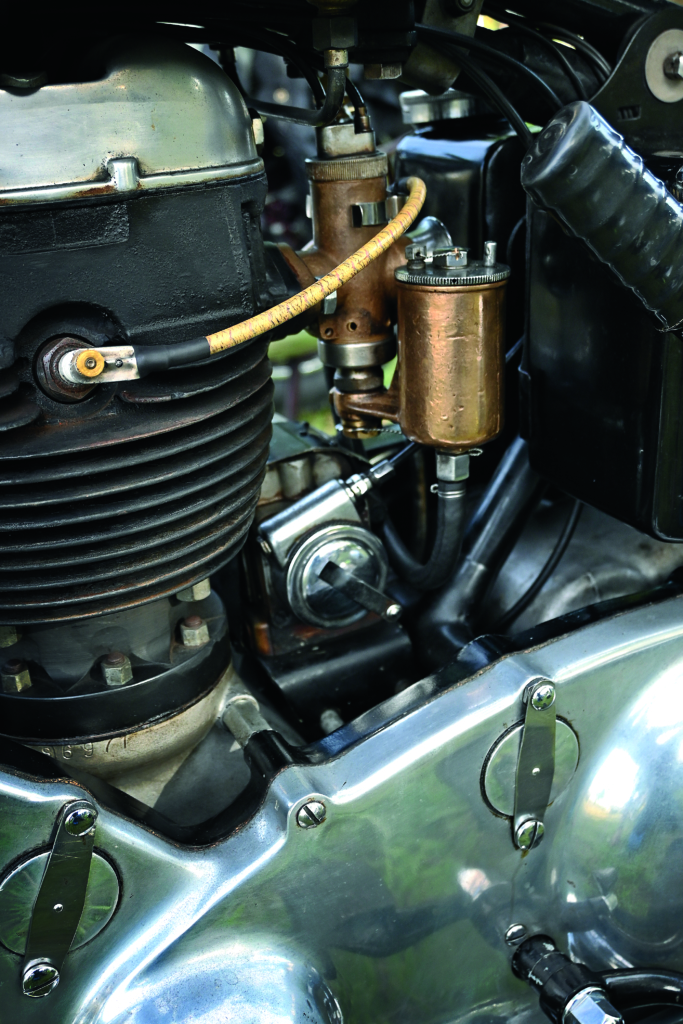
The pair of Rudges went off to a new home in Cootamundra in April 2025, in time for Mark to enter the Special for the event in Goulburn held to celebrate 100 years since the holding of the Australian TT there in 1924. Since then it has had quite a few trouble-free rally outings, most recently the Cootamundra Rally in November 2025 where all was going well until it snapped the gearbox selector linkage. “An easy fix,” says Mark, who says his interest in the marque goes back to one day at Winton where he was impressed with Bryce Davies’ model. “The first thing I noticed was the spoke pattern,” says Mark, “and the more I looked, the more interested I became. I kept my eye out for one for sale, and when the Gaggioni estate came up and I saw the Special I knew that was what I wanted. I prefer this engine to the Ulster because it is easier to work on with the side-mounted spark plug and the simpler rocker arrangement. Another unique feature is that once the cylinder head holding down nuts are removed, the head studs have a hexagonal head hidden inside the nuts. You can then unscrew the studs from the bottom of the head allowing same to be removed without removing the fuel tank. The cylinder can also be removed.
“At the front of the timing case there is a small lever which is called a ‘Half compression lever’. When switched to the horizontal position this partially opens the exhaust valve which allows the engine to be kick-started and run. Then it is tapped back into the ‘down’ position with the foot. Behind that is a tell-tale window which pulses in and out to signify that the oil is circulating.
The mudguards on mine are lighter section than standard, but I like the look of them and I think they suit the bike.”
There’s no doubt that Rudge owners are a special breed, and always have been. The motorcycles are top quality, representing the pinnacle of engineering prowess in their era, and are understandably highly sought after today. And now there’s one more happy Rudge owner, and one more Rudge Special on the road again.
1937 Rudge Special — Specifications
| Specification | Details |
|---|---|
| Engine | Air-cooled OHV single with four-valve head |
| Bore × Stroke | 84.5mm × 88mm |
| Capacity | 495cc |
| Carburation | Amal Type 76/113 with remote bowl |
| Electrics | Miller 6-volt dynamo, battery and BTH magneto |
| Headlamp | 8-inch |
| Gearbox | Rudge-Whitworth patented 4-speed |
| Front Suspension | Rudge girder fork with patented one-piece shackle |
| Rear Suspension | Rigid |
| Front Wheel/Tyre | 3.25 × 19 inch |
| Rear Wheel/Tyre | 3.50 × 19 inch |
| Front Brake | 8-inch SLS |
| Rear Brake | 7.5-inch SLS |
| Wheelbase | 54 inches |
| Seat Height | 27 inches |
| Weight | 400 lb |
| Fuel Capacity | 3.5 gallons |
| Oil Tank Capacity | 0.5 gallons |
| Top Speed | 80 mph |
| Colours | Black, blue or maroon with gold pin striping |
Options
| Option | Additional Cost |
|---|---|
| Upswept exhaust system | 30 shillings |
| Chromium-plated fuel tank | 10 shillings |